

Gardiner Expressway Rehabilitation: Accelerated Delivery Through Advanced Precast Box Girder Solutions
The Frederick G. Gardiner Expressway Rehabilitation is one of Toronto's largest transportation infrastructure renewal projects in recent decades. As a vital route connecting downtown Toronto to the Greater Toronto Area, the Gardiner carries approximately 150,000 vehicles daily and is critical to regional mobility and economic activity.
To extend the life of this aging corridor, the City of Toronto launched a major rehabilitation program that included replacing the six-lane elevated bridge deck and superstructure, rehabilitating the supporting substructure, and installing new roadway lighting while maintaining traffic throughout construction.
DECAST supplied 705 B700 prestressed precast concrete box girders for the reconstruction of the elevated section between Dufferin Street and Strachan Avenue, helping deliver one of Canada's most complex urban infrastructure projects.
Challenge
The 700-metre section required complete superstructure replacement and substructure rehabilitation within a busy urban corridor while keeping traffic moving.
Delivered using a Design-Build model, the project required close collaboration, accelerated construction, and careful coordination with various stakeholders and surrounding operations, including GO Transit, TTC operations, Exhibition Place and construction of the Ontario Line.
Additional challenges included:
- Managing highly restricted overnight construction windows with a 15-minute window for each girder
- Manufacturing, transporting, and installing girders in precise sequence
- Managing differential camber during staged construction
- Maintaining tight installation tolerances while meeting an aggressive schedule
- Coordinating construction alongside GO Transit rail operations, TTC Services, Ontario Line construction, active transit tunnels beneath the surface
Solution
DECAST worked with the project team early in the design process to develop a precast solution that would accelerate construction while meeting long-term performance requirements.
A total of 705 prestressed B700 prestressed concrete box girders were manufactured ranging from 18 to 21 metres in length, 22 to 26 tonnes in weight, and incorporated approximately 400 kilometres of prestressing strand. Each girder was designed for a 75-year service life.
Manufacturing the girders off-site allowed production to occur alongside demolition and substructure rehabilitation, shortening the construction schedule while reducing on-site labour, formwork, and lane closures.
The Design-Build approach encouraged close collaboration between DECAST Ltd, GRASCAN Construction, Torbridge Construction, Doug Dixon and Associates and Stantec resulting in an efficient and coordinated delivery.
Installation & Execution
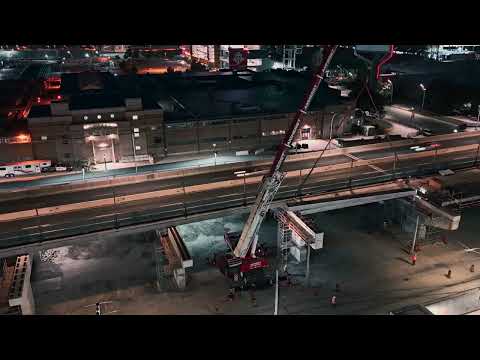
The bridge consisted of 35 spans, with girder installation completed in three phases.
Careful coordination between manufacturing, transportation, and erection crews ensured each girder arrived on site in the correct sequence for installation. To manage differential camber between construction stages, the team used preloading, hold-down systems, and bearing seat adjustments to maintain alignment and installation tolerances.
Work was completed during overnight closures, with crews installing an average of six to seven girders per shift at a rate of approximately 15 minutes per girder, minimizing disruption to surrounding transportation networks.
Key milestones included permanent lane closures beginning on April 8, 2024 followed by the opening of all six lanes on October 27, 2025 – approximately 18 months earlier than the original construction schedule.
Manufacturing Excellence
Early involvement allowed DECAST to optimize girder design for manufacturing, transportation, and installation while improving production efficiency.
Quality assurance included comprehensive material testing, concrete strength verification, prestressing testing, and a final inspection prior to delivery. The combination of advanced precast engineering, efficient manufacturing, and close collaboration helped deliver a durable, high-quality solution on an accelerated schedule.
Off-site manufacturing reduced the need for temporary formwork and allowed fabrication to occur at the same time as demolition and substructure repairs. Faster installation also shortened lane closures, helping reduce traffic congestion, fuel consumption, and vehicle emissions.
Result
By supplying its 705 B700 precast box girders, DECAST helped accelerate construction, reduce disruption, and extend the life of one of Toronto's busiest transportation corridors.
Maintaining traffic throughout construction while completing the project approximately 18 months ahead of a conventional schedule reduced public impacts and restored full corridor capacity sooner.
The Gardiner Expressway Rehabilitation demonstrates how early collaboration, advanced precast engineering, and efficient manufacturing can deliver complex infrastructure projects faster, safer, and with long-term performance benefits for communities across Canada.
Project Details
Location: City of TorontoBusiness Area: Bridges & Girders
Product: B700 Prestressed Box Girder



DECAST is leading the Canadian infrastructure market with water transmission, storm & sanitary, tunneling, bridge & engineered precast products.


Copyright 2026 DECAST LTD. | Accessibility | All Rights Reserved | (800) 461-5632 Developed by MediaSuite Inc.
Registered in Canadian Patent and Trademark Office